
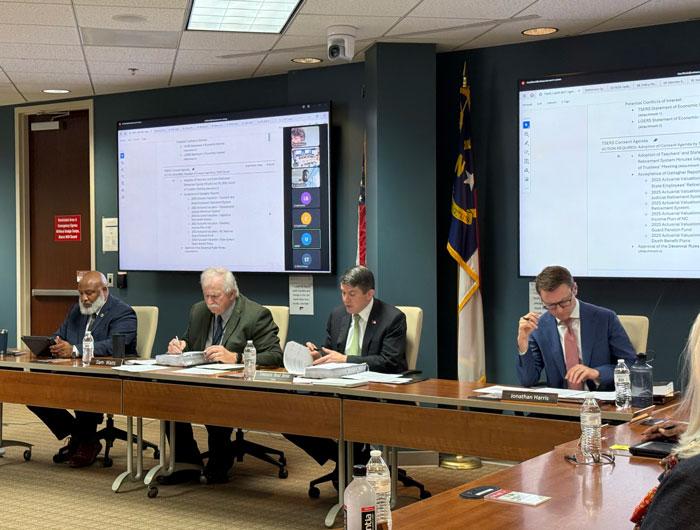
In order to provide potential cost-of-living adjustments (COLA) or other benefits adjustments, financial benchmarks and statutory requirements must be met, members of the Teachers’ and State Employees’ Retirement System (TSERS), and the Local Governmental Employees’ Retirement System (LGERS) Boards of Trustees were told at the regularly scheduled board meeting on November 5.
The boards reviewed an actuarial report from the consulting firm Arthur J. Gallagher & Co. which highlights statutes and policies for benefit improvements for LGERS and TSERS as well as providing a historical and prospective view on gains and losses.
The main drivers of a COLA decision are related to sufficient investment gains in the pension plan. That is determined by the measurement of the North Carolina Retirement Systems’ actuarial value of assets, which was included in the Gallagher report. Decisions also hinge on the importance of protecting the long-term financial health of the Retirement Systems.
Under state law, the TSERS board may recommend benefit improvements to the General Assembly for appropriation, but the board does not have the power to grant them. The LGERS board can approve some benefit improvements in limited circumstances.
Under Retirement Systems’ policy, the boards use what is known as a smoothing method, which measures investment gains and losses over a five-year period. Using that longer view avoids the shock of year-to-year market volatility and provides a more accurate assessment of whether benefit enhancements can be supported by the long-term financial position.
Earlier this year the boards adopted policies that allow greater flexibility when considering potential benefit improvements. Decisions can now be made on more recent financial data to gain a more accurate assessment than the previous policy permitted when considering whether investment gains were sufficient to support a COLA or other benefit enhancement.
Among other items on the agenda, the trustees received a series of reports for the year ending 2025 from Gallagher. The documents provide annual actuarial valuation of assets, measure long-term funding obligations, and project future contribution levels necessary to pay for future benefits for participants in the Retirement Systems. Those included:
- TSERS
- LGERS
- Consolidated Judicial Retirement System of North Carolina
- Legislative Retirement System of North Carolina
- Disability Income Plan of North Carolina
- North Carolina National Guard Pension Fund
- Retiree Health Benefit Fund
- Registers of Deeds’ Supplemental Pension Fund of North Carolina
- North Carolina Firefighters’ and Rescue Squad Workers’ Pension Fund
- Death Benefits Plans of North Carolina
Trustees also received a report on actuarial valuation and OPEB liabilities in the State Health Plan from The Segal Group, a consulting firm.