
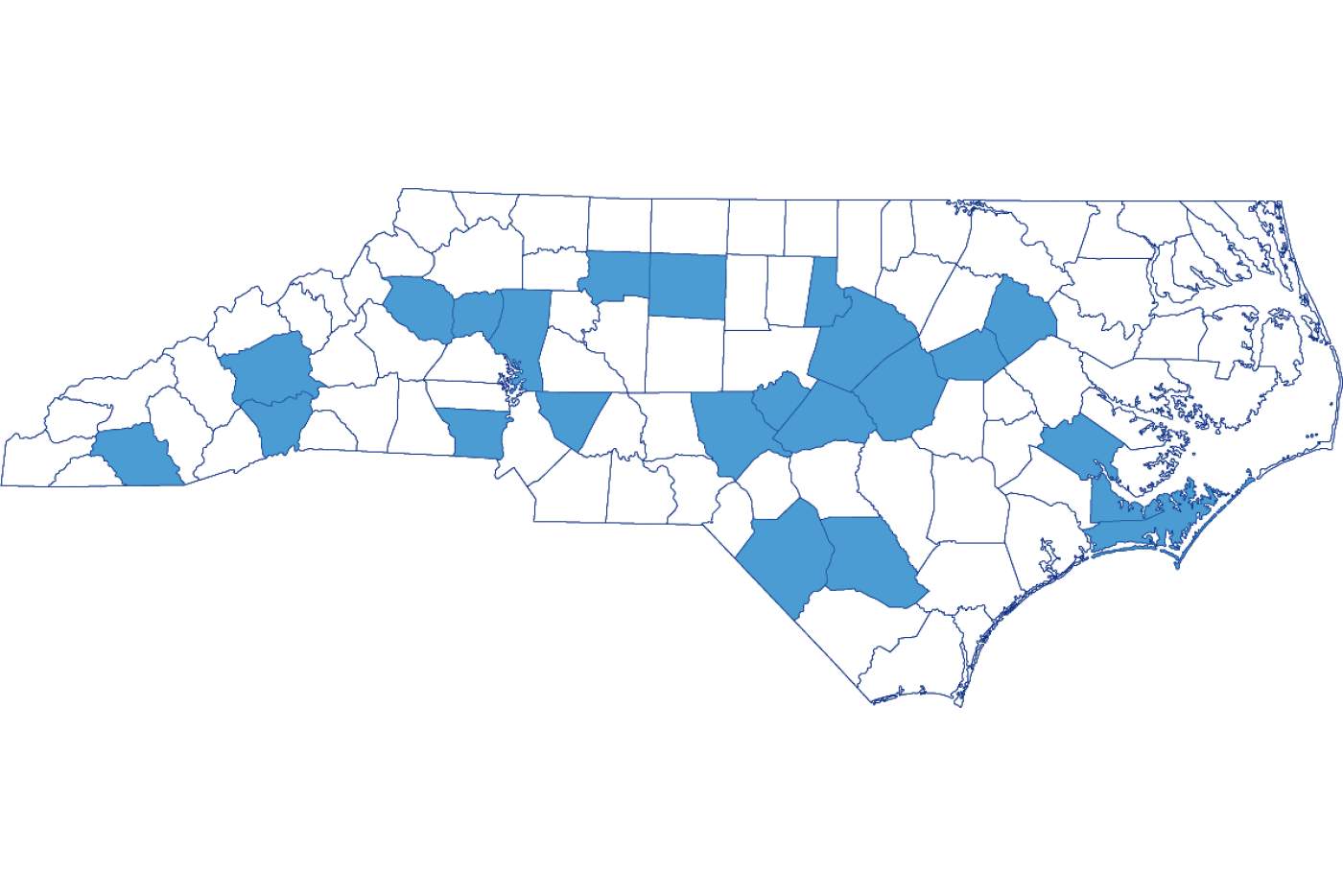
The Local Government Commission today approved a $275,670,000 financing request linked to Duke Health System’s purchase of Lake Norman Regional Medical Center, now known as Duke Health Lake Norman.
The request was submitted by the N.C. Medical Care Commission (NCMCC) for a tax-exempt conduit revenue bond. That type of financing allows for the issuer to loan the bond proceeds to a third party, in this case Duke Health. The hospital system will use proceeds of the bond to refund interim financing and lines of credit used to purchase the assets and related businesses of Lake Norman Regional Medical Center in Mooresville (Iredell County) on April 1.
In all, the LGC approved three funding requests submitted by NCMCC totaling $675 million.
NCMCC received a yes vote to issue a $395 million conduit revenue bond, with proceeds to be loaned to Deerfield Episcopal Retirement Community in Asheville (Buncombe County). The money will be used to acquire, build, renovate, expand and equip Deerfield Episcopal’s continuing care retirement community. Work will involve 12 new skilled nursing units; 12 new memory care units; 10 assisted living units with dining facilities; a community center with dining, library, common space, administrative and meeting facilities; a 69-unit independent-living apartment building; buildings housing 96 independent-living hybrid units; and an outdoor activity center with walking trails.
Proceeds from the third NCMCC conduit revenue bond will be loaned to United Health Centers. The money will be used to pay for acquiring, renovating and equipping the 8,750-square-foot South Side Center Clinic on Kernersville Road in Winston-Salem (Forsyth County).
State Treasurer Brad Briner chairs the LGC. The commission is staffed by the Department of State Treasurer (DST) and has a statutory duty to approve most debt issued by units of local government and public authorities in the state. The commission examines whether the amount of money units borrow is adequate and reasonable for proposed projects and confirms the governmental units can reasonably afford to repay the debt. It also monitors the financial well-being of more than 1,100 local government units.
LGC members approved several other requests for issuance of conduit revenue bonds that were on the agenda. Those include:
- Durham Housing Authority, $29 million. Proceeds will be loaned to Page Road Apartments, a North Carolina limited partnership, to finance a portion of the cost to acquire, build and equip a 160-unt low-and moderate-income multifamily housing development. It will be located on Page Road in Durham (Durham County) and known as Page Corners Apartments. It will include 16 one-bedroom; 64 two-bedroom; 64 three-bedroom; and 16 four-bedroom units.
- Asheville Housing Authority, $24 million. Proceeds will be loaned to Rocky River Apartments, a North Carolina limited liability company, to finance a portion of the cost to acquire, build and equip a multifamily rental housing development to be known as Rocky River Apartments in Woodfin (Buncombe County). It will include 14 one-bedroom units; 52 two-bedroom units; 42 three-bedroom units; and 12 four-bedroom units, all targeting lower-income households.
- Winston-Salem Housing Authority, $20.5 million. Proceeds will be loaned to The Residences at Indiana Avenue, a North Carolina limited liability company, to pay a portion of the cost to acquire, build and equip a multifamily rental housing development on Indiana Avenue in Winston-Salem (Forsyth County). The project will include 180 units targeting low-income households — 27 one-bedroom, 81 two-bedroom and 72 three-bedroom units.
- Gastonia Housing Authority, $19 million. Proceeds will be loaned to Hoffman Homes Preservation, a New York limited partnership, to pay for a portion of the cost to acquire, rehabilitate and equip an 81-unit low- and moderate-income multifamily rental housing development known as Hoffman Homes in Gastonia (Gaston County). Work will include a variety of site and building repairs.
In other action, LGC members approved an application from the city of Raleigh (Wake County) to issue $265 million in revenue bonds. Proceeds will be used to refund previous bond anticipation notes, thereby obtaining permanent financing at reduced costs.
Wilson County received a favorable vote for $40 million in limited obligation bonds for education and general government purposes. Proceeds will be used to acquire, build and equip a new Frederick Douglass Elementary School in Elm City. Its historic forerunner, built in 1939, served black students during segregation. It has been razed. Proceeds also will help to finance renovation of the County Government Center; acquire, build and renovate two EMS facilities; provide a grant to the city of Wilson for an infrastructure project; build, renovate and equip a new county tax administration building; acquire, build and equip a County Sheriff’s training center; and acquire, build and equip a new county maintenance facility. Limited obligation bonds do not require voter approval.
Henderson County got a green light to issue $45 million in limited obligation bonds. Proceeds will be used to finance the costs of construction and equipping a new medical office building and related site improvements to expand UNC Health Pardee’s outpatient and primary care services within the county. Site improvements also will be done as part of the property purchase to support economic development and industrial recruitment initiatives.
The city of New Bern (Craven County) successfully petitioned LGC members to sign off on $24 million in general obligation bonds. Of that, $10 million in bonds will be for streets and sidewalks maintenance, $8 million will be for parks and recreation to improve outdated parks and expand facilities and $6 million will be for stormwater infrastructure to help mitigate flooding. General obligation bonds require voter approval. All three bonds were approved by referendum in October by 69.61%, 65.74% and 75.58%, respectively.
The town of Clayton (Johnston County) received approval of $21 million in limited obligation bonds for a variety of property purchases, construction, renovation and other town projects. Capacity constraints in some town-run departments will be addressed, and future economic development opportunities will be enhanced.
Robeson County is building and equipping a new technical school for Robeson County Public Schools to support workforce development. County officials successfully asked the LGC to approve $15 million in limited obligation bonds to finance a portion of the cost. The project began in October 2023. It is expected to be completed by July 2026.
LGC members approved Macon County’s application for $10.5 million in special obligation bonds to build a new landfill cell to allow for adequate disposal capacity for future years. Otherwise, existing capacity will be full by July 2026.
The LGC also approved requests submitted by:
- Sanford (Lee County), about $7.3 million for a State Revolving Fund loan for sewer work.
- Beaufort (Carteret County), nearly $6.5 million in U.S. Department of Agriculture revenue bonds for town water distribution improvements.
- Catawba Valley Medical Center, nearly $3.5 million for a lease financing agreement to expand medical office space at its facility in Lenoir (Caldwell County).
- Harrisburg (Cabarrus County), $2.35 million for a general obligation transportation bond.
- Lumberton (Robeson County), $1.9 million for an installment financing contract to build Pennington Park soccer fields, restroom facilities and a splash pad.
- Harnett County, $689,356 for an installment financing contract to purchase TASERS and cameras for the Sheriff’s Department.
- Pinebluff (Moore County), $400,000 for an installment financing contract to perform repairs at Pinebluff Lake Dam, which was damaged by Hurricane Chantal. The approval was contingent on Pinebluff first confirming whether state grant funds might be available for the work.
- White Lake (Bladen County), $210,000 for an installment financing contract to purchase three police interceptor vehicles.
LGC members approved a statement (See Attachment D here) related to the potential incorporation of the community of Bethlehem (Alexander County), in response to a request from local residents. Under N.C. Gen. Stat. 120-163(c), residents seeking to incorporate a new municipality must receive from the LGC a statement regarding the proposed municipality's prospects for financial viability and effective fiscal management. The statement adopted by the LGC reflects its belief that the town is likely to be financially viable and that the community has indicated a commitment to sound fiscal policies and safeguards. However, the statement also highlighted the ongoing statewide shortage of qualified local government finance professionals, which presents a significant challenge to sustaining strong financial management practices. The statement is neither a recommendation for nor against incorporation.
Commission members granted an appeal from the town of Speed (Edgecombe County) not to withhold a portion of its sales tax distribution. The town has not submitted required annual audits since 2022. By law the LGC may direct the state Department of Revenue to withhold a portion of sales tax distribution from counties and municipalities that are not in compliance with annual audit requirements. Speed is in the process of dissolving its municipal charter.
N.C. Capital Facilities Finance Agency Meeting
The N.C. Capital Facilities Finance Agency (NCCFFA), which is staffed by DST personnel, met prior to the LGC meeting and approved seeking a conduit revenue bond for $31.5 million. The LGC then approved the financing at its meeting. Bond proceeds will be loaned to Triad Goodwill to finance the construction and outfitting of the Sustainability Center in Greensboro (Guilford County) for recycling operations. Two outdated warehouses will be consolidated into one modern 175,780-square-foot facility. That will free up 67,500 square feet of space to create an Opportunity Campus dedicated to career development and workforce development services.
State Treasurer Brad Briner chairs the seven-member NCCFFA, which facilitates tax-exempt financing to nonprofit institutions providing elementary and secondary education, private higher education institutions and various other public-interest, special-purpose projects. Treasurer Briner pushed to revise agency guidelines to lengthen the amount of time bonds mature from 20 or 25 years to 40 years in an attempt to make financing through NCCFFA more attractive than taking the business out of state. Activity and interest in NCCFFA financing have increased since the guidelines were changed.
In other matters, Betty Parker was appointed to the NCCFFA board by Gov. Josh Stein and attended her first meeting.