
The Local Government Commission (LGC) approved a financing request from the city of Charlotte today that will help pay for construction of a fourth runway at Charlotte Douglas International Airport. That was one of Charlotte’s six financing requests totaling $1.5 billion that the LGC approved.
Charlotte Douglas, the world’s seventh-busiest airport for takeoffs and landings, according to industry rankings, is building the runway to address capacity and to meet future demands. The LGC vote authorized Charlotte to issue $215 million in revenue bonds for the runway work. The commission also approved $175 million in revenue bond anticipation notes for existing runway rehabilitation, work on the terminal and other projects at the airport.
Charlotte’s other successful requests were for $530 million in revenue bond anticipation notes to finance wide-ranging extensions, additions, and improvements and replacement of water and sewer system infrastructure and equipment; a $505 million revenue bond, proceeds of which will pay off a prior, short-term bond anticipation note; $65 million in revenue bonds to refund existing bonds at a savings; and $9 million in revenue bonds to refinance outstanding transportation bonds to achieve savings and more favorable financing terms.
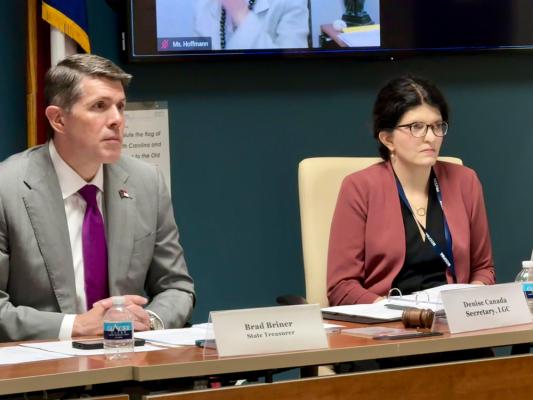
State Treasurer Brad Briner chairs the LGC. The commission is staffed by the Department of State Treasurer (DST) and has a statutory duty to approve most debt issued by units of local government and public authorities in the state. The commission examines whether the amount of money units borrow is adequate and reasonable for proposed projects and confirms the governmental units can reasonably afford to repay the debt. It also monitors the financial well-being of more than 1,100 local government units.
In other matters, the LGC approved the Plan of Action submitted by the town of Speed (Edgecombe County) concerning the distribution of the town’s assets as it works to voluntarily surrender its charter. The town of 63 residents was incorporated in 1901, but in recent years has had significant issues of noncompliance with state statutes related to financial management.
The town owns several parcels of property that would be transferred to Edgecombe County and the Speed Volunteer Fire Department. Cash on hand, currently totaling $42,000, would be transferred to Edgecombe County. Edgecombe County has developed plans to create a “A Historic Town of Speed Committee” which would advise the county manager how to best spend the funds for the betterment of the community. Anticipated tax receipts and personal property would also be transferred to Edgecombe County. The town has no known outstanding debt or contractual obligations.
LGC members were updated on the progress that Rocky Mount (Nash and Edgecombe counties) has made in getting its financial house in order. Last month the LGC issued the city a warning it was in peril of the LGC taking control of the city’s finances because of overspending and weak fiscal control practices.
The LGC received an update on the town of Littleton’s efforts to comply with the statutory requirement to submit to the LGC an annual financial audit. Staff reported that the town submitted its FY 2020–21 audit on May 1, 2026; four additional audits remain overdue. The town also discussed potentially merging its water and wastewater system with a larger system.
Numerous financing requests were on the agenda, including a successful application from N.C. Municipal Power Agency No. 1 to issue $350 million in revenue bonds. Proceeds will be used to refund existing bonds used for improvements at Catawba Nuclear Station. The transaction is expected to generate savings of $10.8 million. The power agency is a co-op arrangement comprising 19 cities and towns. It generates and purchases electricity for sale to member cities. It is managed by ElectriCities of North Carolina.
LGC members signed off on $168.7 million in financing spread across four requests from the Raleigh Housing Authority (Wake County). The conduit revenue bonds allow the authority to loan proceeds to third-party developers. The money will be used by North Carolina companies to build multifamily rental housing developments:
$62 million in bond proceeds will be loaned to The Pointe at Town Center LP to build The Pointe at Town Center, a 192-unit development, and $31 million in bond proceeds to build The Pointe at Town Center II, a 96-unit development. Both developments will be on Sumner Boulevard.
$42 million in bond proceeds will be loaned to Chapanoke JV LLC to finance part of the construction of Chapanoke Apartments, a 200-unit development on Chapanoke Road.
$33.7 million in bond proceeds will be loaned to Standard Compassionate Drive Venture LP to finance part of the construction of Joyfield at Compassionate Drive, a 200-unit development.
The LGC gave a green light to the city of Raleigh (Wake County) to issue $157.5 million in limited obligation bonds, which do not require voter approval. Proceeds from the bond anticipation notes will be used to relocate and expand Red Hat Amphitheater and for expansion of the Raleigh Convention Center.
Johnston County won approval to issue $134.5 million in limited obligation bonds to finance the design and construction of a new building, and to raze the existing Clayton High School and related structures. The new school will provide modern learning spaces and enhanced safety features, and accommodate over 2,000 students in an area experiencing population growth. No tax increase is anticipated. In a separate matter, LGC members approved about $12.3 million to refinance outstanding general obligation school bonds to achieve savings.
The LGC authorized Henderson County to issue $102 million in limited obligation bonds to build a new four-story courthouse annex with new courtrooms, and county court-related offices and to renovate the existing courthouse as part of the county’s judicial center complex.
Asheville (Buncombe County) got a thumbs up to issue $51.1 million in revenue bonds. Proceeds will be used to finance costs of improving the Mills River Water Treatment Plant, to enhance other water infrastructure, and to refund an existing bond series at lower repayment costs.
The LGC signed off on a request from Winston-Salem (Forsyth County) to issue $37.8 million in general obligation bonds. Proceeds will be used to refund prior bonds. A separate approval was given for $10.4 million of two-thirds general obligation bonds to pay for a host of streets, parks, public safety, public facilities and housing projects.
The Asheville Housing Authority (Buncombe County) received a favorable vote on its request for $18 million in conduit revenue bonds. Proceeds will be loaned to Roers Asheville Apartments Owner LLC, a Minnesota company, to build a 126-unit multifamily rental housing development on Pine Loop.
Wake Forest (Wake County) got a favorable vote on its application for an $18 million installment financing contract to acquire, build and equip a new fire station on Wait Avenue.
The LGC approved a request from Nags Head (Dare County) to use $14 million in special obligation bonds for beach nourishment. The project will address erosion control, flood and hurricane protection.
Other requests approved by LGC members were from:
- Washington (Beaufort County), a nearly $10 million loan through the State Revolving Fund to build a new water holding basin and to make water treatment plant upgrades.
- Stanly Water and Sewer Authority (Stanly County), about $9.9 million in interim financing for the expectation of U.S. Department of Agriculture revenue bonds to extend water lines about 12 miles in the Palestine area of the county.
- Morehead City (Carteret County), an $8.2 million installment financing contract to build a gym with spectator seating and restroom facilities and to renovate an existing gym, among other recreation projects.
- High Point (Guilford, Randolph, Davidson and Forsyth counties), about $5.6 million in two-thirds general obligation bonds to make physical and safety improvements to Triangle Lake Road.
- Newton (Catawba County), about $5.6 million to execute an installment financing contract. The money will be used to replace outdated facilities with a new fire station in the Startown area.
- Catawba Valley Medical Center (Catawba County), about $4.5 million in financing to extend a lease agreement for warehouse space.
- Goldsboro (Wayne County), a $3.8 million installment financing contract to purchase vehicles and install equipment for use by city departments.
- Lucama (Wilson County), a $905,000 State Revolving Fund loan to replace 4,000 feet of deteriorating water line.
- Wallace (Duplin and Pender counties), $224,000 in an installment financing to purchase three marked and one unmarked police vehicles.
- Hertford County, a $121,582 lease financing agreement for three police vehicles.
- Lilesville (Anson County), a $55,000 lease financing contract for a service truck to supplement the town’s aging vehicle fleet.